Year 2 -14 December 2025 –Phuket -Thailand
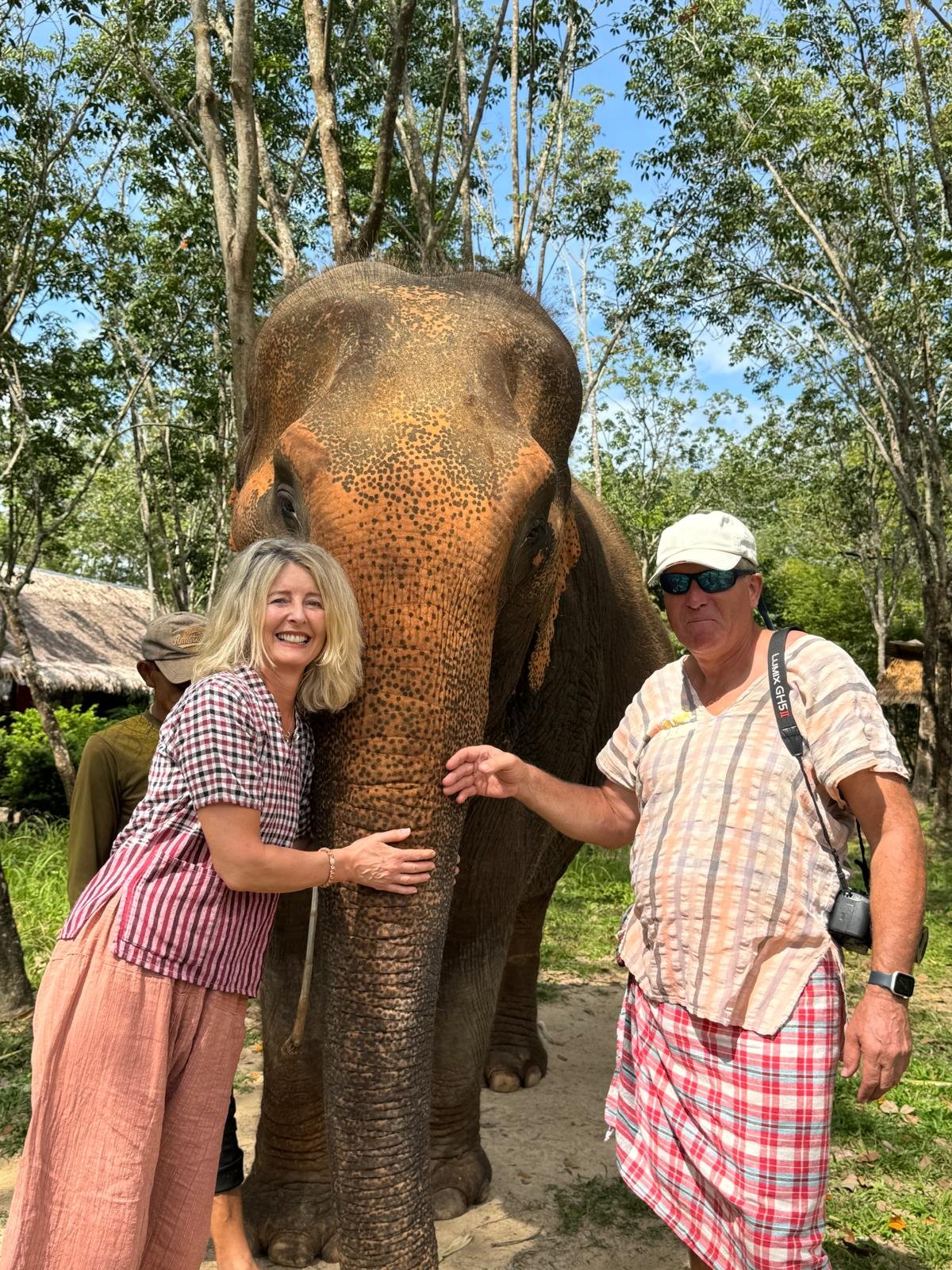
We had another hearty breakfast and had decided to go and visit the Elephant sanctuary they have on Koh Yai Yai.
The elephant has been a contributor to Thai society and it has been its icon for many centuries. The elephant has had a considerable impact on Thai culture. The Thai elephant is the official national animal of Thailand. The elephants found in Thailand is the Indian elephant, a subspecies of the Asian elephant. In the early-20th century there were an estimated 100,000 captive elephants in Thailand. In mid-2007 there were an estimated 3,456 captive elephants left in Thailand and roughly a thousand wild elephants. By 2017, the number of captive elephants had risen to an estimated 3,783. The elephant became an endangered species in Thailand in 1986.
There are three species of elephant: two African species and the Asian elephant. Asian elephants are divided into four sub-species, Sri Lankan, Indian, Sumatran and Bornean. Thai elephants are classed as Indian elephants. However, Thai elephants have slight differences from other elephants of that sub-species. They are smaller, have shorter front legs, and a thicker body than their Indian counterparts. With age their heads, ears and feed take on a more brown colour.
Elephants are herbivores, consuming ripe bananas, leaves, bamboo, tree bark, and other fruits. Eating occupies 18 hours of an elephant's day. They eat 100-200 kilograms of food per day. A cow (female) will eat 5.6 percent of her body weight per day. A bull (male) will eat 4.8 percent. Thus a 3,000 kilogram cow will consume 168 kg per day, a 4,000 kg bull 192 kg per day. As elephants can digest only 40 percent of their daily intake, the result is dung amounting to 50–60 kg daily. As elephants will not eat in unclean surroundings befouled by their own dung and their instinct is to roam to a new area.
In Thai society elephants have played a substantial role in manual labour, war, royal iconography, and the tourism industry. For thousands of years, elephants were captured and trained to be a form of transport and heavy labour. When logging in Thailand was still legal, they hauled heavy logs through forests, which in turn gave many Thai people jobs. In recorded Thai history, during the reign of King Ramkhamhaeng the Great of Sukhothai, Thais used to hunt and trade elephants.
Known for their strength and intelligence, elephants were used as war elephants since the days of Alexander the Great. They were referred to as warm-blooded armoured tanks. Each elephant has a distinctive personality. Male elephants that were aggressive but considered "tameable" were selected to be war elephants.
For a very long time, it was a law that when a white elephant was found and a tradition that when an elephant with good build was found, it was to be presented as property to the King of Thailand. The Thai sacred and royal symbol was the white elephant. They are not albinos but are genetically different. White elephants are not white, they are a dusky pinkish grey.
Logging was banned in Thailand in 1989. Logging had been the primary occupation of Thai elephants and their mahouts (those that look after their own elephant for life). After the ban, elephants trainers had to find other ways to feed themselves and their elephants. Most of them turned to the entertainment industry and tourism. Many mahouts took their elephants to Bangkok, roaming the streets with baskets of fruits for the tourists to buy and feed the animal. Elephants now had to beg for food and perform tricks or act as party props in exchange for money
On 17 June 2010, elephant protection laws were passed making these acts illegal. An Asian Elephant Range States Meeting in 2017 estimated the number of captive elephants in Thailand at 3,783. The Department of Livestock Development says that some 223 elephant camps exist in the country. They fall into three categories: camps for observation purposes only; non-riding camps that allow other activities; and elephant riding camps.
King Vajiravudh (Rama VI) in 1921 decreed in the Wild Elephant Protection Act that all wild elephants were the property of the government, to be managed by the Department of the Interior as the King's representative. Elephants with special features—white elephants—were to be presented to the king. Historically, elephants in Thailand are considered to be very important culturally. There are many elephant's references to artworks, literature and national emblems. As Thailand is a majority Buddhist country, elephants are portrayed as sacred animals from their special symbolism in the practice of Buddhism. Many artworks in Thai royal palaces and temples have drawings of elephants on the paintings on the walls. In 1917, Thailand's official flag was a white elephant in the middle of the scarlet background. White elephants in Thai society also represent wealth and power because of their past association with the Thai royals. The royal Thai navy flag also bears the symbol of the white elephant. Many provinces in Thailand used to have elephants as part of their official emblems as well. In the Thai animal and planetary zodiac, the elephant is the fourth animal zodiac of the Thai people.
Asian elephants share a close relationship with the Thai people, from being used warriors on battlefields, worshiped as religious icons, and faithful labourers to loggers. Environmental exploitation, massive landslides, and mudflows led the government to ban logging in Thailand in 1986. This led to almost 70% of domesticated elephants to be out of work.
We were picked up at the hotel and taken by truck some 15 minutes into the island to the Kha Yao Elephant Sanctuary. The journey took us through urban sprawl which makes you feel so sheltered in the hotel which is like a luxury enclave. There were lots or wooden huts and shacks and the usual rubbish and lots of motorbikes and cars etc. It was interesting to see and the farm areas and how simple life seems. It was like going back to the villages and shacks of Indonesia and in reality that is their way of life.
We came to the sanctuary and were given a welcome drink and some rice cake. We were then asked to change into some clothes they prepared for us as we may get muddy. These as you can imagine were quite a fashion item!!
We were then introduced to Wassena, a 54 year (they know from the microchip) old female elephant who was 4 tons. She used to be a working elephant up in Chang Mai and was brought here some years ago. She eats up to 10% of her bodyweight every day i.e. 40kg. She eats for about 18 hours a day and sleeps for about 4. She does have teeth and during their lives elephants have 6 sets of teeth. He dung is used for fertilizer. She had never had offspring.
We were introduced to Wassana and made a rice ball to give to her in which we put a banana and tamarind and we had to put our hand up to her mouth and under her trunk where she had a massive tongue. This went well but we both withdrew our hands quite quickly. Her Mahout (lifetime carer who stayed with us all the time) has been with her for a number of years and will stay until one or the other dies. There is an elephant language the Mahout’s have with the elephants. Once we had both given Wassana a rice ball we walked along with her and the Mahout to a bridge where we then gave her some sugar cane stalks which had been cut into small bits. Wassana stuck out her trunk and would not just take one but would wait until we gave her about 6 pieces before putting them into her mouth. She would adeptly roll them with her trunk so she could take more pieces.
Once the sugar beat was gone we walked on again to another area where there was a pile of discarded pineapple plants. Wassana would collect a bunch and then whack them against her leg or a tree trunk to discard the roots and earth. She continued to eat bunches for some time. She was alert to the sound of cars arriving etc. When she flicks her ears and tail she was happy and content. However, when she stopped doing that she was alert and aware of what was going on. Apparently they can smell another elephant or animal from 15 km away.
We walked on again and we came to a muddy area and we were invited to smear mud into her skin which we did but we had to be careful not to get sprayed by Wassana who would suck up mud and water from her trunk and spray herself (and anything in the way). We then walked on to a flat area where there were hoses and we then gave Wassana a good spray down. This was all great fun and they are such wonderful creatures and an amazing feat of nature. Wassana had a lovely nature.
We changed and cleaned ourselves up and then had some watermelon to refresh ourselves. We had had an excellent guide called Shi whose English was very good. Shi led us over to the kitchen area and as an extra we had a cooking lesson and learnt to cook Thom Yum, a soup, and crunchy chicken with cashew nuts. This took about an hour and we then eat these delicious dishes with some Pad Thai they had cooked.
It had been an excellent visit and we had really enjoyed it. We returned to the hotel and had a swim and relaxed before another great supper.
The picture of the day is of course the lovely elephant Wassana.
Need/Opportunity Year Three
In year three I will be going from Thailand to Sri Lanka, India, Maldives and then on to Mauritius, Reunion, Cape Town, St Helena, Azores and back to the UK.
I am looking for crew from Mauritius/ Reunion Island to Cape Town and from Cape Town to the UK. If of any interest do email me.
The blog will continue as we continue the journey. If you have any comments or suggestions about the blog then do email me on hine.nick9@gmail.com